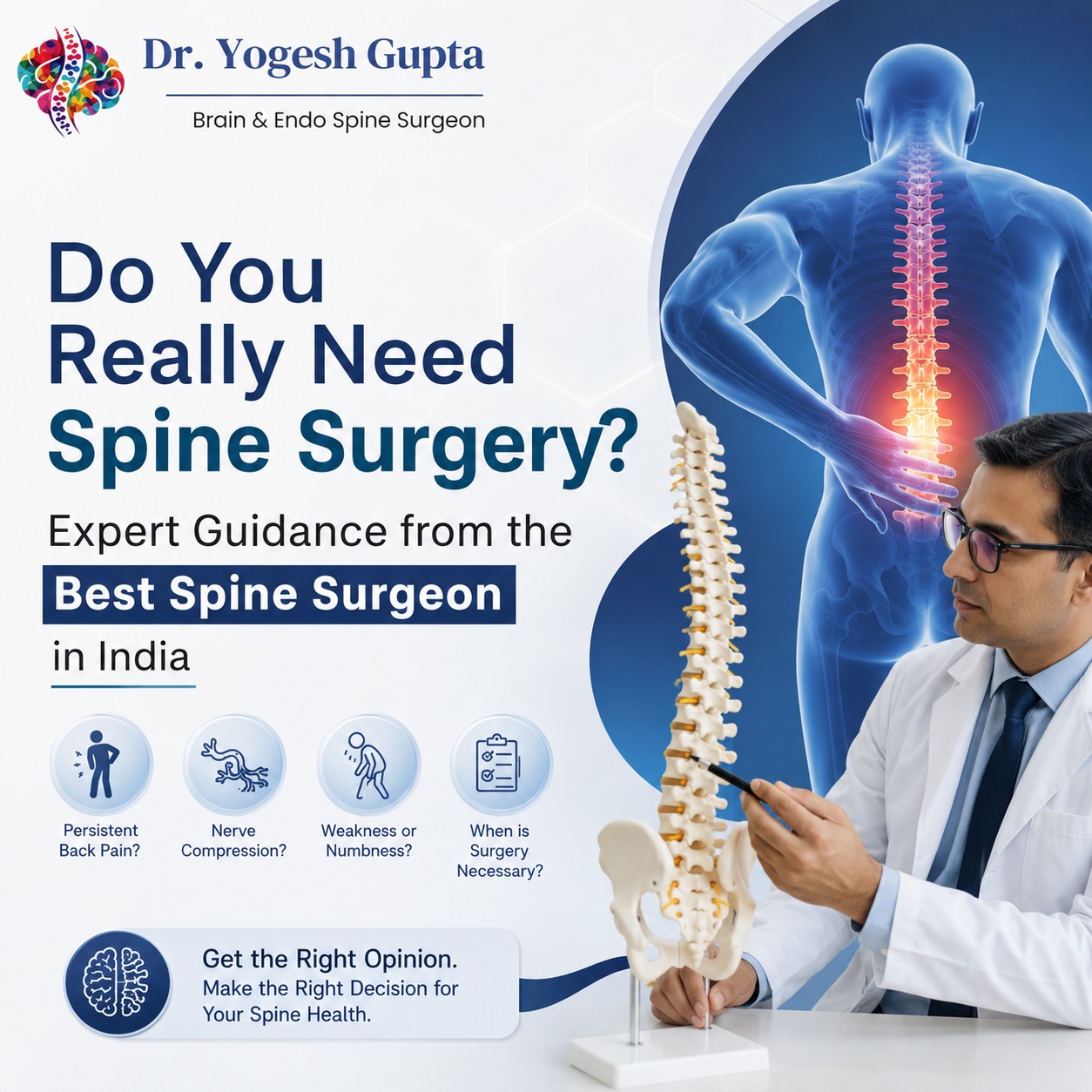
Pain in the back, neck, numbness and difficulty in moving around could make your daily routine difficult. In case all the medication, physiotherapy and change in lifestyle has failed to relieve you of these symptoms, then patients often start asking if spine surgery is the last option left for them. But then there is no requirement of spine surgery for all the cases involving the spine.
Spine treatments have advanced tremendously with time. In some cases, there could be minimally invasive surgeries which may be done instead of conventional spine surgeries. Dr. Yogesh Gupta aims to diagnose the problem in each individual patient and recommend the most appropriate spine treatment, including minimally invasive spine surgery such as Unilateral Biportal Endoscopy (UBE) in the cases where it could be beneficial.
If you are looking for Best Spine Surgeon in India, then you should know that not all the cases require surgery.
Not at all! There are different types of spine conditions that can be managed without having to go through surgery. Depending on the findings from the diagnosis, your treatment can range from medication, physiotherapy, to lifestyle changes. Seeing the Best Spine Surgeon in India will give you insights about your condition and help you manage it in the best way possible.
For instance, those with back pains and slipped discs may respond well to non-operative treatment. However, where symptoms continue to persist, where there is evidence of nerve damage, or a diagnosis confirms that surgery is needed, then the operation will become an appropriate alternative.
It is important not to base your decision only on the basis of pain. It is critical for a specialist to examine your case and determine what causes the problem.
A neurosurgeon may consider surgery when non-surgical treatment has not provided adequate improvement or when there is significant nerve or spinal cord compression.
Situations that may require surgical evaluation include:
1. Persistent or worsening pain despite appropriate conservative treatment
2. Significant nerve compression
3. Progressive weakness or numbness
4. Difficulty walking or maintaining balance
5. Certain cases of spinal canal or foraminal stenosis
6. Some cases of herniated or slipped discs
7. Spinal instability or selected spinal injuries
8. Certain spinal tumors or other structural abnormalities
9. Symptoms associated with serious neurological compromise
The exact recommendation varies from patient to patient. Imaging findings such as MRI or CT results must also be interpreted together with the patient's symptoms and clinical examination.
A responsible surgical decision begins with diagnosis rather than immediately choosing an operation.
Your neurosurgeon may review your medical history, symptoms, neurological examination and previous treatments. Depending on the suspected condition, imaging such as an MRI, CT scan or X-ray may be recommended.
The specialist may then discuss:
1. What is causing your symptoms?
2. Can the condition be treated without surgery?
3. What are the expected benefits of surgery?
4. What are the possible risks?
5. Which surgical technique is appropriate?
6. What could happen if surgery is delayed?
7. What should you expect during recovery?
This process helps patients understand their options instead of making a decision based solely on fear or the severity of pain.
Advances in spine surgery have introduced techniques designed to reduce disruption to surrounding tissues. One such approach is Unilateral Biportal Endoscopy (UBE).
UBE uses specialized endoscopic instruments through small access points and can be used for selected spinal conditions. The technique is designed to provide the surgeon with visualization and working access while limiting the size of the surgical approach.
According to Dr. Yogesh Gupta's website, UBE is used for selected conditions including spinal canal stenosis, foraminal stenosis, ossification of the ligamentum flavum, low-grade spondylolisthesis and adjacent segment degeneration. The website also highlights potential advantages such as smaller incisions, reduced tissue damage, less blood loss, shorter hospital stays and faster recovery.
However, minimally invasive surgery is not appropriate for every patient. The choice of technique depends on the patient's diagnosis, anatomy, medical history and the surgeon's assessment.
One of the biggest advantages of consulting an experienced spine specialist is obtaining a clear understanding of the problem before deciding on treatment.
A proper evaluation can help determine whether:
1. Your condition can improve with non-surgical treatment
2. Further diagnostic testing is required
3. Surgery is appropriate
4. A minimally invasive approach may be suitable
5. Another type of procedure may be more appropriate
6. Continued monitoring is reasonable
This is particularly important because two people with similar symptoms may have completely different underlying spinal conditions and therefore require different treatment plans.
It might become necessary for you to visit a neurosurgeon when you have symptoms from the spine that are interfering with your day-to-day activities. It would be necessary to consult a neurosurgeon in this case to help establish whether the symptoms are related to the disc issue, spinal stenosis, nerve compression, injuries to the spine, or any other spine disorders.
Dr. Yogesh Gupta is a neurosurgeon who specializes in performing brain surgery and spine surgery. According to his website, Dr. Gupta has over 16 years of experience and has performed over 15,000 brain and spine surgeries. If you are seeking the Best Brain Surgeon in India, some of the things that you need to take into account are experience, skills in surgery, diagnosis, treatment options, and the way the specialist treats his patients.
The consultation with a specialist should not only focus on whether surgery is required. It should also focus on diagnosing the condition, treatment options, and the most appropriate treatment option.
Spine surgery involves delicate structures surrounding the spinal cord and nerves. Therefore, treatment planning requires careful diagnosis, appropriate imaging review and consideration of both surgical and non-surgical options.
Dr. Yogesh Gupta is a neurosurgeon specializing in brain and spine surgery and is associated with Priyush Neuro & Super Speciality Hospital in Mansarovar, Jaipur, and Priyush Multispeciality Hospital in Sanganer, Jaipur. His website highlights more than 16 years of experience, 15,000+ successful brain and spine surgeries and expertise in minimally invasive techniques including UBE.
Rather than assuming that surgery is necessary, patients should discuss their individual diagnosis, available treatment options, expected benefits and potential risks with their treating specialist.
The question is not simply, “Do I have back pain, so do I need surgery?” The more important question is “What is causing my symptoms, and which treatment is appropriate for my condition?”
Many spinal problems can be managed without an operation, while others may benefit from surgery when conservative treatment is unsuccessful or neurological problems develop. Modern techniques such as UBE have also expanded the minimally invasive options available for selected patients.
If you are considering spine surgery, seek a detailed evaluation from a qualified neurosurgeon rather than making a decision based only on pain or online information. An individualized assessment can help you understand whether surgery is necessary, which treatment options may be appropriate and what you can realistically expect from treatment.
Dr. Yogesh Gupta provides specialized brain and spine care with a focus on advanced and minimally invasive neurosurgical techniques. Patients can discuss their symptoms and treatment options with the specialist to determine the most appropriate course of care.
No. Severe pain does not automatically mean surgery is required. The cause of the pain, neurological findings, imaging results and response to conservative treatment all influence the treatment decision.
Yes. Many slipped-disc cases can improve with non-surgical treatment. Surgery may be considered when symptoms persist, neurological problems develop or there is significant nerve compression.
UBE, or Unilateral Biportal Endoscopy, is a minimally invasive endoscopic spine technique that uses small access points and specialized instruments. It can be used for selected spinal conditions depending on the patient's individual diagnosis.
No. The appropriate surgical technique depends on the condition, anatomy, severity, previous treatments and overall health of the patient. A specialist evaluation is necessary before selecting a procedure.
You should consider a specialist consultation when back or neck pain persists, repeatedly returns, interferes with daily activities or is associated with numbness, weakness, radiating pain, walking difficulties or other neurological symptoms.
The decision is generally based on symptoms, clinical examination, diagnostic imaging, previous treatment and the expected benefits and risks of surgery. Your neurosurgeon should discuss these factors with you before recommending an operation.
In many cases, non-surgical treatments are considered before surgery. However, some conditions may require earlier surgical intervention, particularly when there is significant neurological compromise or another structural problem that cannot be adequately managed conservatively.





.jpg)